Training often overemphasizes dwell time while underemphasizing pre-cleaning. This guide explains why no disinfectant can overcome poor cleaning, and how a microfiber + chlorine dioxide 3-step protocol improves both microbial control and surface performance in commercial facilities.
The Most Overlooked Training Failure: Skipping True Pre-Cleaning
Facility Managers regularly train on:
- Proper dilution
- PPE compliance
- Dwell time requirements
- Pathogen kill claims
But the foundational principle is often under-taught:
Disinfectants cannot penetrate soil.
When organic material (proteins, oils, biofilm, dust) is present, it:
- Shields microbes from contact
- Reacts with oxidizers
- Reduces effective concentration
- Shortens real-world dwell time performance
Even EPA-registered disinfectants are tested on pre-cleaned surfaces.
If staff spray over visible soil and start timing dwell time, the process has already failed.
Why Surfaces Must Be Clean Before They Can Be Disinfected
The Science Behind It
Microorganisms attach to surfaces within microscopic irregularities. When soil accumulates, microbes embed within:
- Organic films
- Biofilm matrices (EPS — extracellular polymeric substances)
- Dried protein residues
Disinfectants act by chemical contact.
If contact is obstructed, log reduction decreases significantly.
This is why regulatory guidance consistently states:
“Pre-clean visibly soiled surfaces prior to disinfection.”
But in real-world facilities, production speed often overrides this step.
The Dwell Time Problem: Why Training Falls Flat
Most training programs emphasize:
“Keep the surface wet for X minutes.”
But staff behavior often includes:
- Wiping immediately after spraying
- Spraying too lightly
- Allowing surfaces to air dry prematurely
- Using cloths already loaded with soil
Without proper pre-cleaning, longer dwell times do not compensate for blocked chemistry.
More chemical does not equal better performance.
Process control equals better performance.
Why Good Cleaning Often Beats Excessive Disinfection
Routine high-touch surfaces (offices, schools, administrative spaces) do not always require hospital-level disinfection cycles throughout the day.
What they require is:
- Soil removal
- Residue elimination
- Consistent surface hygiene
- Reduced cross-contamination
When microfiber mechanically removes 99%+ of bacteria under proper conditions, and chlorine dioxide provides mild oxidation without residue buildup, the microbial burden drops dramatically before formal “disinfection” even begins.
In many routine maintenance environments:
Effective cleaning reduces risk more sustainably than chemical saturation.
The 3-Step Protocol: Spray, Damp Wipe, Dry Wipe
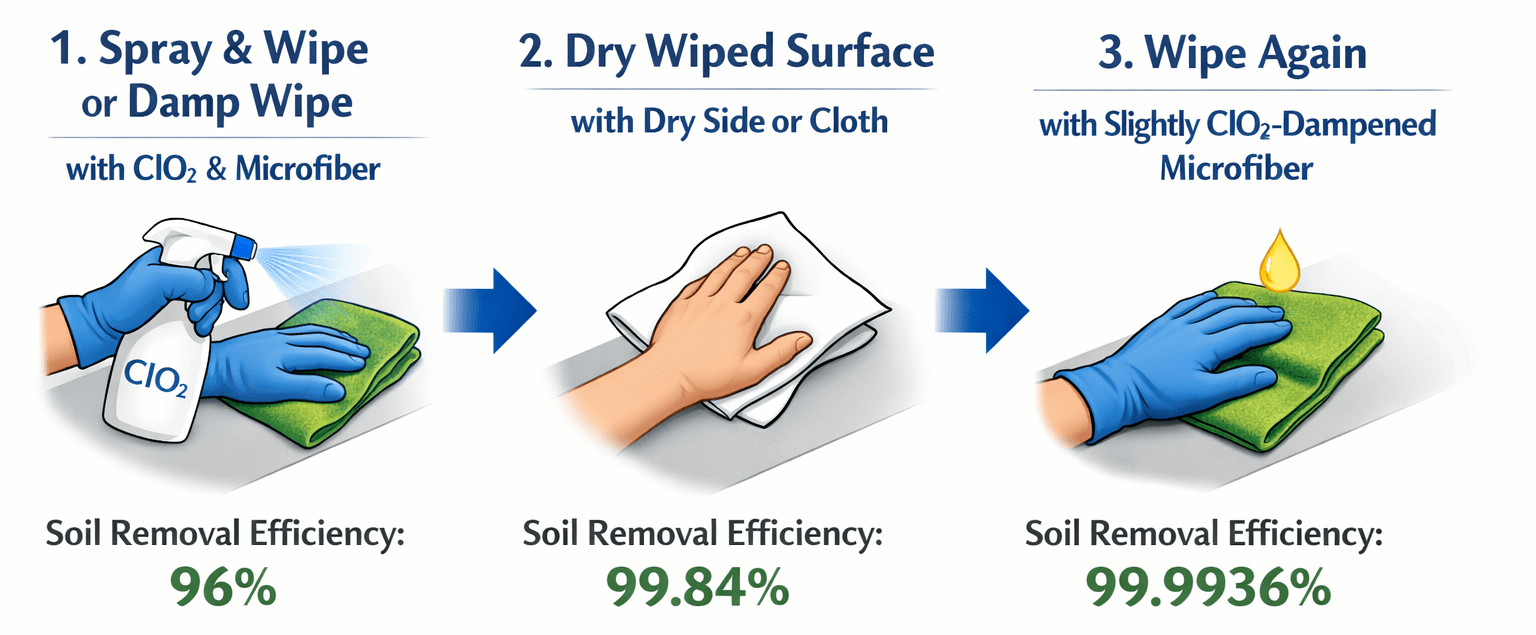
This system integrates cleaning and disinfection efficiency.
Step 1: Spray (or Squirt)
Apply properly diluted ClO₂ solution evenly across the surface.
Purpose:
- Light oxidation
- Soil loosening
- Initial microbial disruption
Avoid over-saturation.
Step 2: Damp Wipe (Microfiber)
Using a clean, color-coded microfiber cloth:
- Mechanically remove soil
- Capture microbial load
- Distribute solution evenly
Microfiber’s split-fiber structure increases surface contact and soil capture through capillary action.
This step does the majority of the work.
Step 3: Dry Wipe
Use a second clean microfiber cloth to:
- Remove remaining moisture
- Eliminate suspended residue
- Prevent streaking
- Improve surface finish
Result:
A physically clean, residue-free surface with dramatically reduced microbial load.
Why Residue Matters More Than Most Training Covers
Quaternary ammonium compounds (quats) and some detergents leave cationic films that:
- Attract dust
- Trap soil
- Reduce slip resistance
- Build up on high-touch surfaces
- Interfere with future cleaning cycles
Residue creates a re-soiling loop.
Low-to-no residue ClO₂ cleaning avoids this cycle.
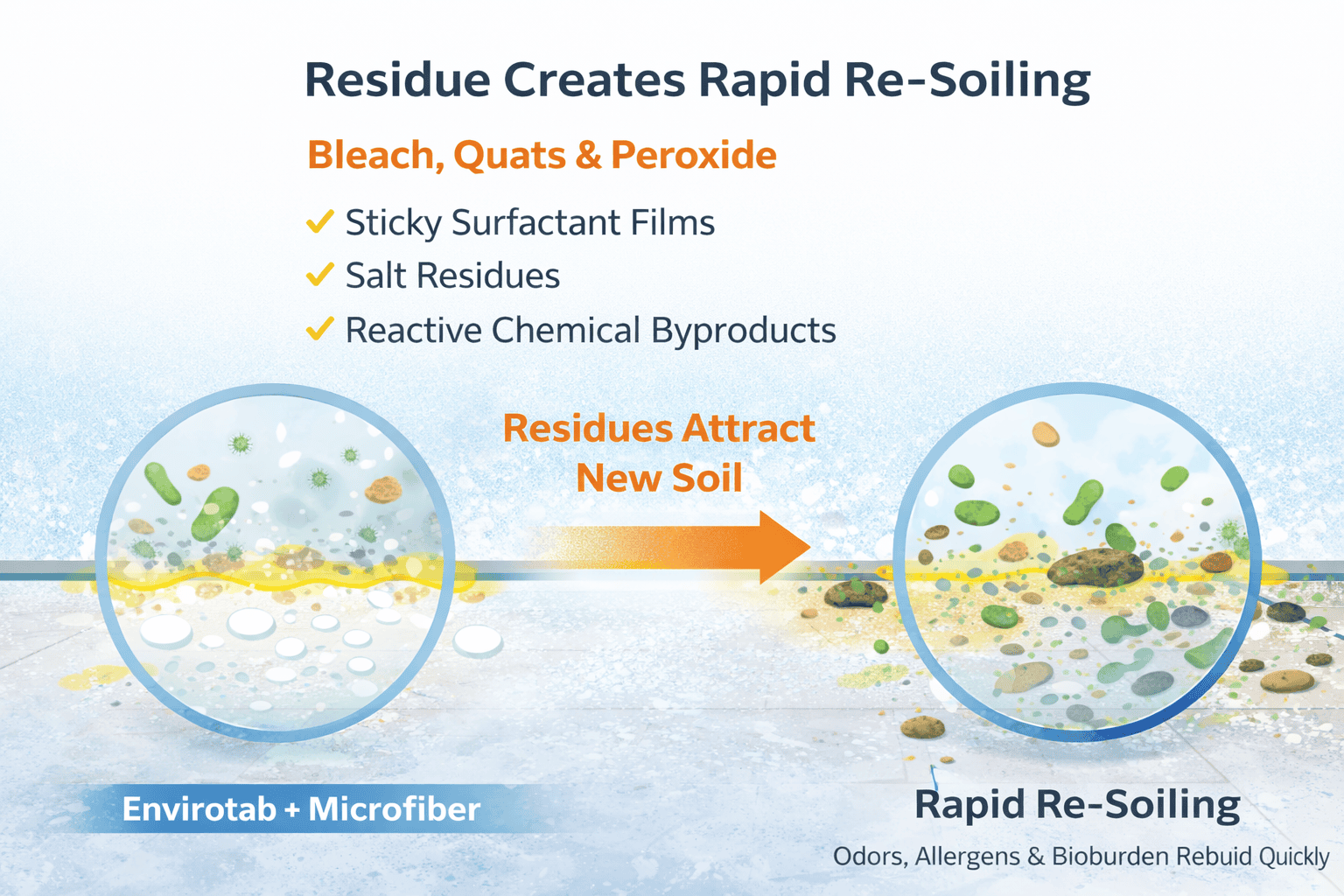
Residue-free surfaces:
- Stay cleaner longer
- Require less chemical
- Improve indoor air quality
- Reduce staff rework time
When Full Dwell-Time Disinfection Is Required
Certain scenarios still require strict dwell-time adherence:
- Known pathogen outbreak
- Medical facilities
- Bodily fluid contamination
- High-risk populations
- Regulatory compliance mandates
In these cases:
- Pre-clean thoroughly.
- Reapply ClO₂ solution.
- Allow full label-specified dwell time.
- Avoid premature wiping.
The difference is that the surface is now chemically accessible.
The Operational Cost of Over-Disinfection
Overuse of heavy disinfectants leads to:
- Surface damage
- Increased corrosion
- Chemical exposure risk
- Higher chemical spend
- Staff fatigue
- Odor complaints
Training staff to rely on process rather than chemical strength lowers long-term costs.
Building a Better Training Module
Facility Managers should emphasize:
- Clean first — always.
- Mechanical removal is primary.
- Chemistry supports cleaning.
- Dwell time only matters on clean surfaces.
- Avoid residue accumulation.
- Audit technique, not just product use.
Shift the mindset from:
“Spray stronger.”
To:
“Clean smarter.”
The Modern Cleaning System Mindset
A balanced system includes:
- Microfiber mechanical removal
- Low-residue cleaning chemistry
- Chlorine dioxide oxidation support
- Proper dwell-time enforcement when required
- Surface longevity protection
This approach reduces microbial risk while preserving facility assets.